
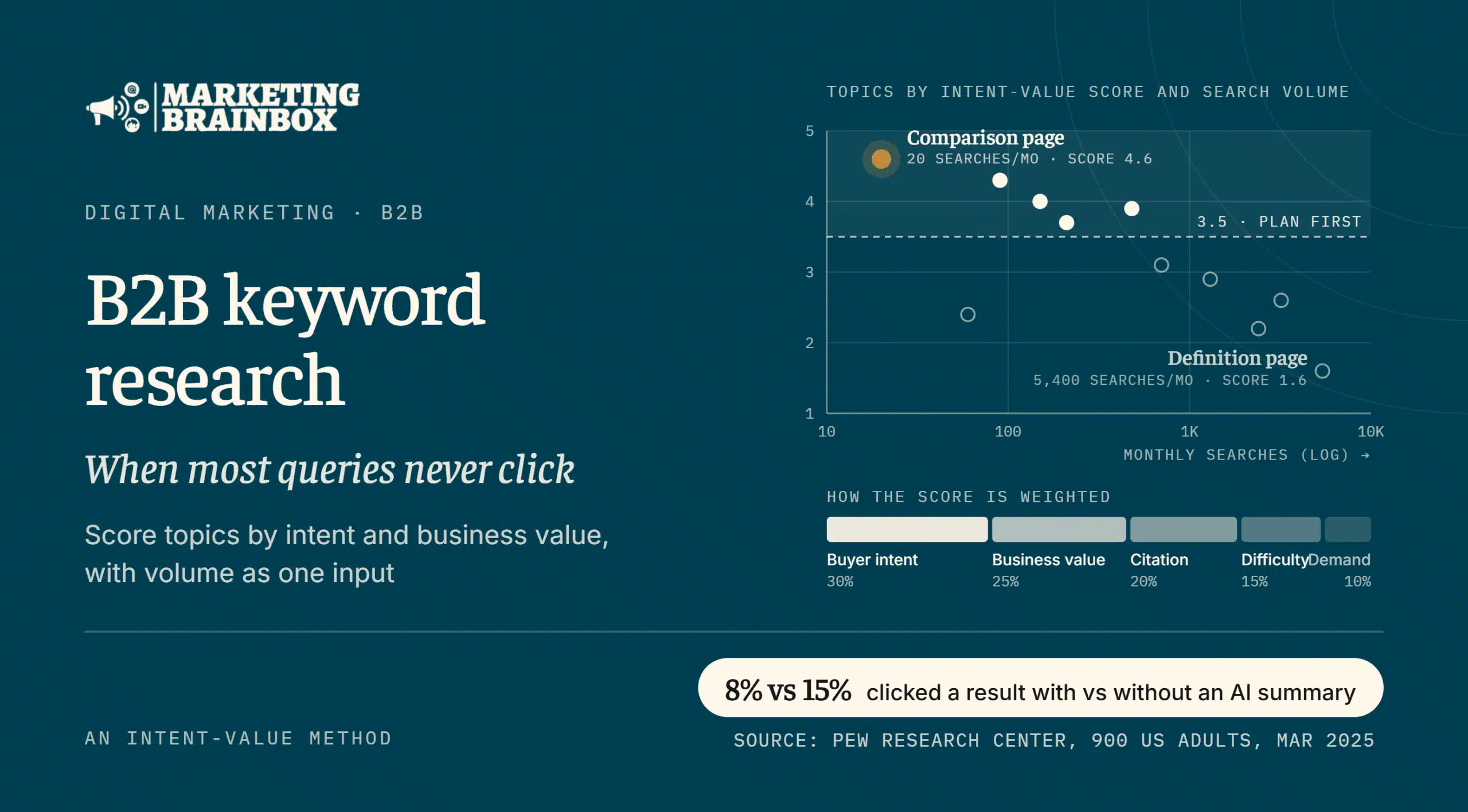
Open most B2B keyword research spreadsheets, and the first sorted column is monthly search volume. That habit made sense when a ranking reliably produced visits. It makes less sense now. Search results answer more questions on the page, AI summaries sit above the links, and many B2B buyers start research in a chatbot rather than a search box.
Pew Research Center tracked the browsing of 900 US adults in March 2025 and found that users who saw a Google AI summary clicked a traditional result in 8% of visits, against 15% when no summary appeared. Only 1% of visits included a click on a link inside the summary, according to Pew. We will cover zero-click search in depth separately. For B2B keyword research, the lesson is simple: volume is a weak proxy for value, and you need a better way to choose topics.
| Quick answer: Modern B2B keyword research starts from buyer questions, not volume. Group queries into topics, score each topic on intent, business value, citation potential, and competition, then add prompt research to see how AI tools answer. Choose formats that both rank and get cited, such as comparisons, definitions, and frameworks, and measure success with assisted pipelines, branded search, and AI mentions as well as clicks. |
Why volume-first keyword research misleads B2B teams
Three things went wrong with the volume-first habit, and only one of them is new:
- B2B volume was always small and noisy. A query with 70 searches a month from IT directors can be worth more than one with 7,000 from students.
- Tool estimates are rough at low volumes, and many valuable B2B queries show as zero.
- Informational queries with high volume are the ones most likely to be answered by an AI summary, so their traffic value has dropped the most.
The fix is not to ignore search data. It is to move volume from the first column to one input among several.
Step 1: Start with buyer questions.
Collect the questions buyers ask before you open a keyword tool. Good sources:
- Sales call recordings and notes, especially first calls and objections
- Customer support tickets and onboarding questions
- Search Console queries, including long, low-volume ones
- People Also Ask boxes and related searches
- Community threads on Reddit, LinkedIn, and industry forums
- The questions prospects type into chatbots, gathered through prompt research (Step 4)
Write each question in the buyer’s words. These become the raw material for topics and often for H2s and FAQs.
Step 2: Group queries into topics.
Search engines and AI tools understand topics, not single strings. Group questions and keywords that share the same intent into one topic, and plan one page per topic. “What is an MQA,” “MQA definition,” and “marketing qualified account meaning” belong on one page. This step prevents cannibalization before it starts, and it feeds directly into your topic cluster plan.
Step 3: Score each topic with intent-value scoring.
Score every topic from 1 to 5 on five factors, then weight them. The weights below suit most B2B publishers and SaaS sites. Adjust them for your goals.
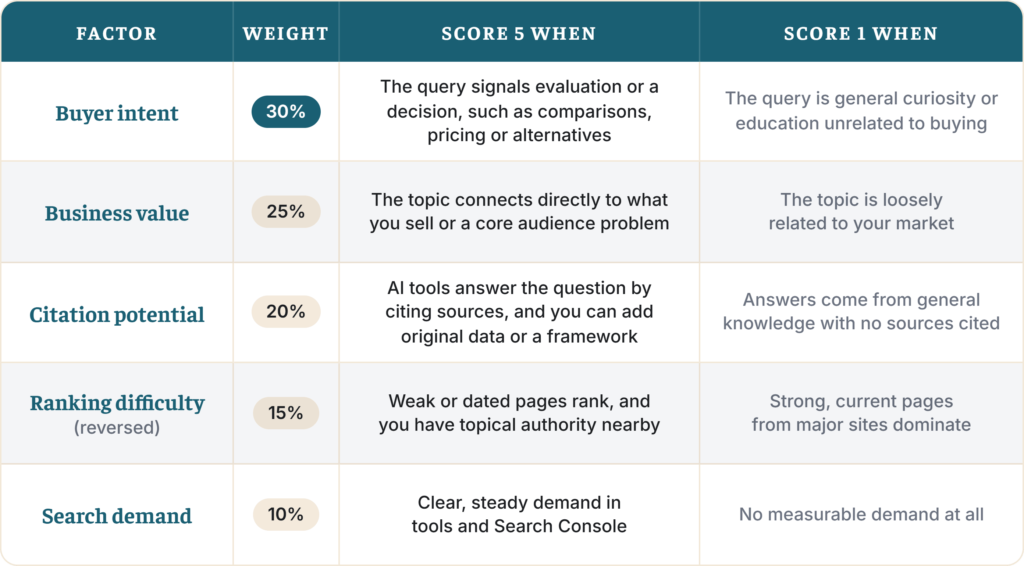
Multiply each score by its weight and add them up for a total out of 5. Topics above about 3.5 go into the plan first. A topic can score well with low volume, which is exactly the point: a comparison page read by twenty serious buyers a month may produce more pipeline than a definition page read by two thousand.
Step 4: Add prompt research.
Prompt research is keyword research for AI tools. Take your top topics and ask them, in natural language, in ChatGPT, Perplexity, Gemini, Claude, and Google AI Mode. Record:
- Whether the answer cites sources, and which ones
- Which brands are mentioned, and how are they described
- Which sub-questions the answer covers that your page does not
- Whether the answer is out of date or wrong in ways your page can correct
Run each prompt a few times, because AI answers vary. Prompts that consistently cite third-party sources are your best citation targets. Our guide to AI visibility tracking explains how to turn this into a repeatable measurement.
Step 5: Pick the format that wins both
Some formats earn clicks and citations better than others because they hold information an AI summary cannot fully replace:
- Comparisons and alternatives, with clear criteria and tables
- Frameworks, templates, and checklists people want to keep
- Original data, benchmarks, and survey findings
- Clear definitions written so a model can quote them accurately
- Pricing and cost breakdowns with dates and sources
- Step-by-step implementation guides with real detail
For each topic, write down the format and the information gain: what your page will add that the top results do not. The generative engine optimization guide covers how to structure pages so AI tools can extract and cite them.
Step 6: Map topics to clusters and links
Assign each scored topic to a pillar and cluster, decide which page links to which, and set the anchor text. Topics that score high on intent usually link up to an educational pillar, and the pillar links down to them. This is where B2B keyword research turns into site architecture rather than a list.
Step 7: Measure more than clicks
If you choose topics for value, measure value. Alongside rankings and organic sessions, track:
- Assisted conversions and pipeline from organic visitors
- Growth in branded search, which often rises when AI tools mention you
- Brand mentions and citations in AI answers for your tracked prompts
- Engagement on high-intent pages, such as comparison and pricing pages
- Search Console impressions for topics where clicks are low
Expect some pages with falling clicks to be working well. If impressions, citations, and branded search rise, the topic is still doing its job.
How often to repeat the research
Treat B2B keyword research as a cycle, not a one-time project. Rescore your topic list every quarter, because AI answers, competitors, and buyer questions change faster than they used to. Repeat prompt research monthly for your top 20 to 30 prompts, so you can see whether citations move after you publish or update a page. Pull fresh questions from sales and support at the same time. Each cycle usually adds a handful of new topics, retires a few that no longer fit, and flags pages that need an update rather than a new article.
A worked example
A marketing software company compares two topics. “What is content marketing?” has high volume but general intent and low business value for a B2B tool and answers that AI tools give without citations. ” The top content audit tools for B2B” have far less volume, strong buyer intent, direct business value, and AI answers that cite comparison pages. Intent-value scoring puts the second topic first, even though a volume sort would rank it near the bottom.
Common mistakes in B2B keyword research
- Dropping topics because a tool shows zero volume
- Writing one page per keyword variant instead of one page per intent
- Ignoring sales and support questions, which are the closest thing to real buyer language
- Skip prompt research so you never see how AI tools describe your category
- Judging every page by clicks alone
FAQs:
How has keyword research changed in 2026?
It has moved from volume-first lists to topic-based planning that weighs buyer intent, business value, and the chance of being cited in AI answers alongside search demand.
What is zero-click keyword research?
It is keyword research that accounts for searches answered on the results page or by AI summaries, valuing topics by intent and visibility rather than expected clicks alone.
Is search volume still useful for B2B?
Yes, as one input. It shows demand, but for B2B it is often small and noisy, so weigh it below intent and business value.
What is prompt research?
Asking AI tools your target questions in natural language and recording which sources and brands they cite, what they cover, and where they are wrong.
Which content formats get cited by AI tools?
Comparisons, frameworks, original data, clear definitions, dated pricing breakdowns, and detailed how-to guides are among the formats most often used as sources.
How do you measure SEO when clicks fall?
Track impressions, assisted pipeline, branded search growth, AI citations for tracked prompts and engagement on high-intent pages.