
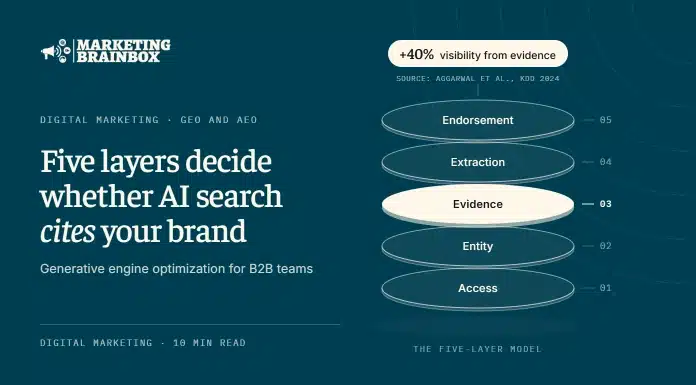
The search used to end with a list of links. Increasingly it ends with an answer. Google’s AI Overviews and AI Mode, ChatGPT, Perplexity, and Copilot now summarize the web and cite a handful of sources. Everyone else gets nothing.
For B2B brands the stakes are higher than traffic. Buyers use these tools to build vendor shortlists, and a brand that never appears in the answer is not on the list.
This guide to generative engine optimization explains how AI answers choose their sources, separates what is proven from what is guesswork, and gives you a five-layer model for improving how often your brand is cited.
| Quick answer
Generative engine optimization (GEO) is the practice of making content easy for AI systems such as ChatGPT, Perplexity, and Google AI Mode to find, trust, and cite. For B2B brands it rests on five layers: Access (crawlable and indexable), Entity (clear about who you are), Evidence (sources, data, and original research), Extraction (answer-first structure and tables), and Endorsement (mentions on reviews, media, and communities). Google says no special markup is needed, so strong SEO comes first. |
What generative engine optimization and AEO mean
Generative engine optimization (GEO) is the practice of improving how often and how accurately your content is cited or mentioned in AI-generated answers. The term comes from a 2023 research paper, covered below.
Answer engine optimization (AEO) is the older, narrower idea of structuring content so search features and assistants can lift a direct answer: question-led headings, short answers, definitions, and structured data.
In practice the two overlap so much that the label matters less than the work. Both build on SEO, because AI answers mostly draw on pages that are already crawlable and indexed. GEO adds attention to evidence, structure, and third-party mentions.
What changed in search: the 2026 numbers
- About 68% of US Google searches ended without a click from January to April 2026, according to SparkToro’s analysis of Similarweb data.
- An Ahrefs study published in February 2026 found AI Overviews linked to a 58% drop in click-through rate for top-ranking pages, as reported by TechWyse.
- A randomized field experiment published in April 2026 found that AI Overviews reduced outbound organic clicks by 39.8% (MediaCat summary).
- In a G2 survey reported in March 2026, 51% of B2B software buyers said they now start research in an AI chatbot more often than in Google.
There is a counterweight. Seer Interactive found that brands cited in AI Overviews earned a 15.74% paid click-through rate on the same queries, compared with 11.19% when not cited, according to TechWyse’s summary. Being cited still pays, even when fewer people click.
How AI answers choose their sources
The details differ between products, but most AI search answers follow four steps:
- Retrieve: the system searches an index or the live web for pages related to the question.
- Rank: it selects the passages that look most relevant and trustworthy.
- Synthesize: a language model writes an answer from those passages.
- Cite: it links to some of the sources it used.
Two things follow. First, if your page cannot be crawled or indexed, it cannot be retrieved, however good it is. Second, the model works with passages, not whole pages, so a clear, self-contained answer is easier to use than a point buried in a long paragraph.
Google is explicit on the first point. Its guidance on AI features says there are no additional requirements or special optimizations needed to appear in AI Overviews or AI Mode, beyond being indexed and eligible to show a snippet. The same preview controls, such as nosnippet, apply.
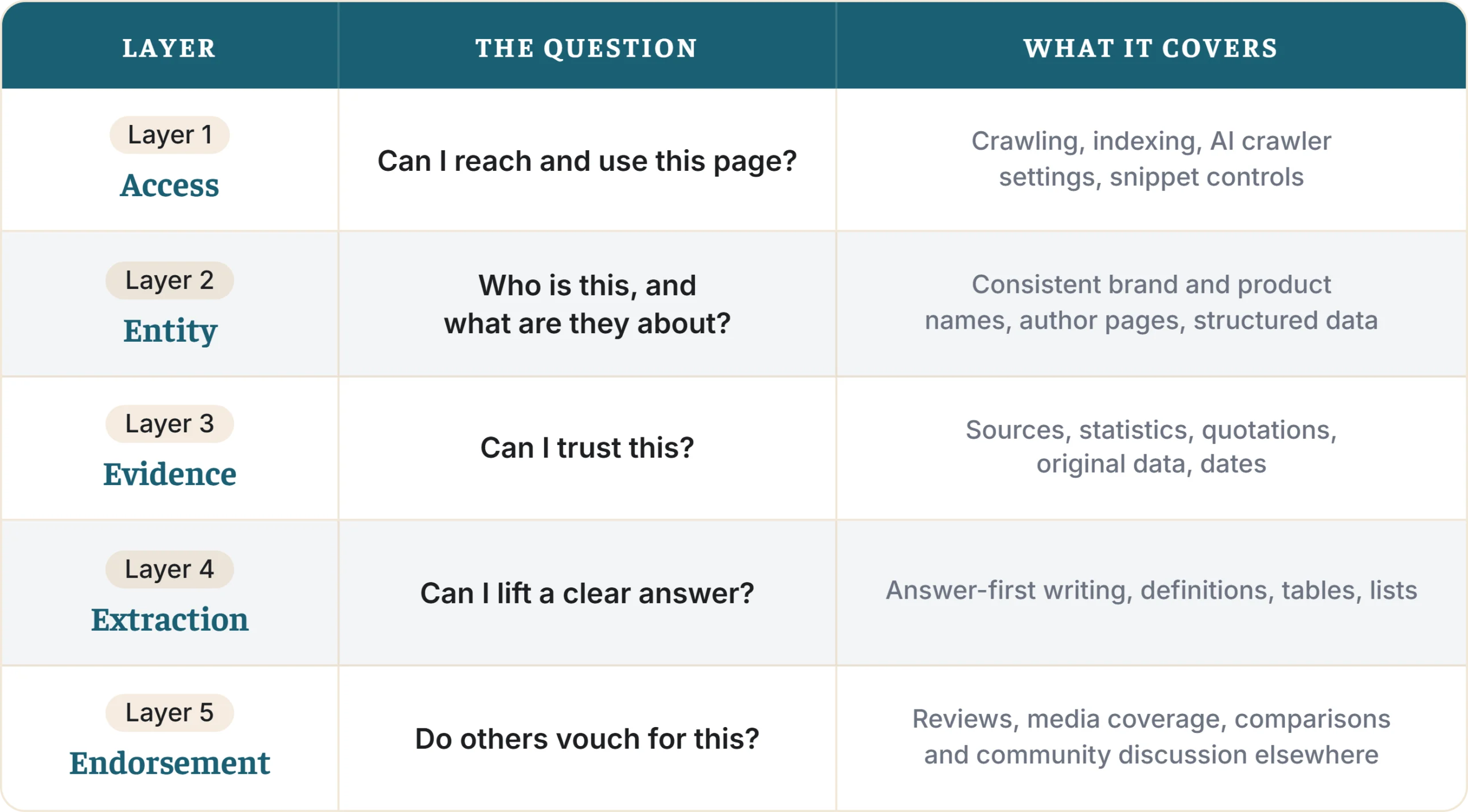
The five-layer AI visibility model
Each layer answers one question an AI system implicitly asks about your content.
Layer 1: Access
Start with the basics: pages that matter should be indexable, fast, and free of blocking rules. Then decide how you treat AI crawlers. Each major provider separates search crawling from model training, so you can make different choices for each.
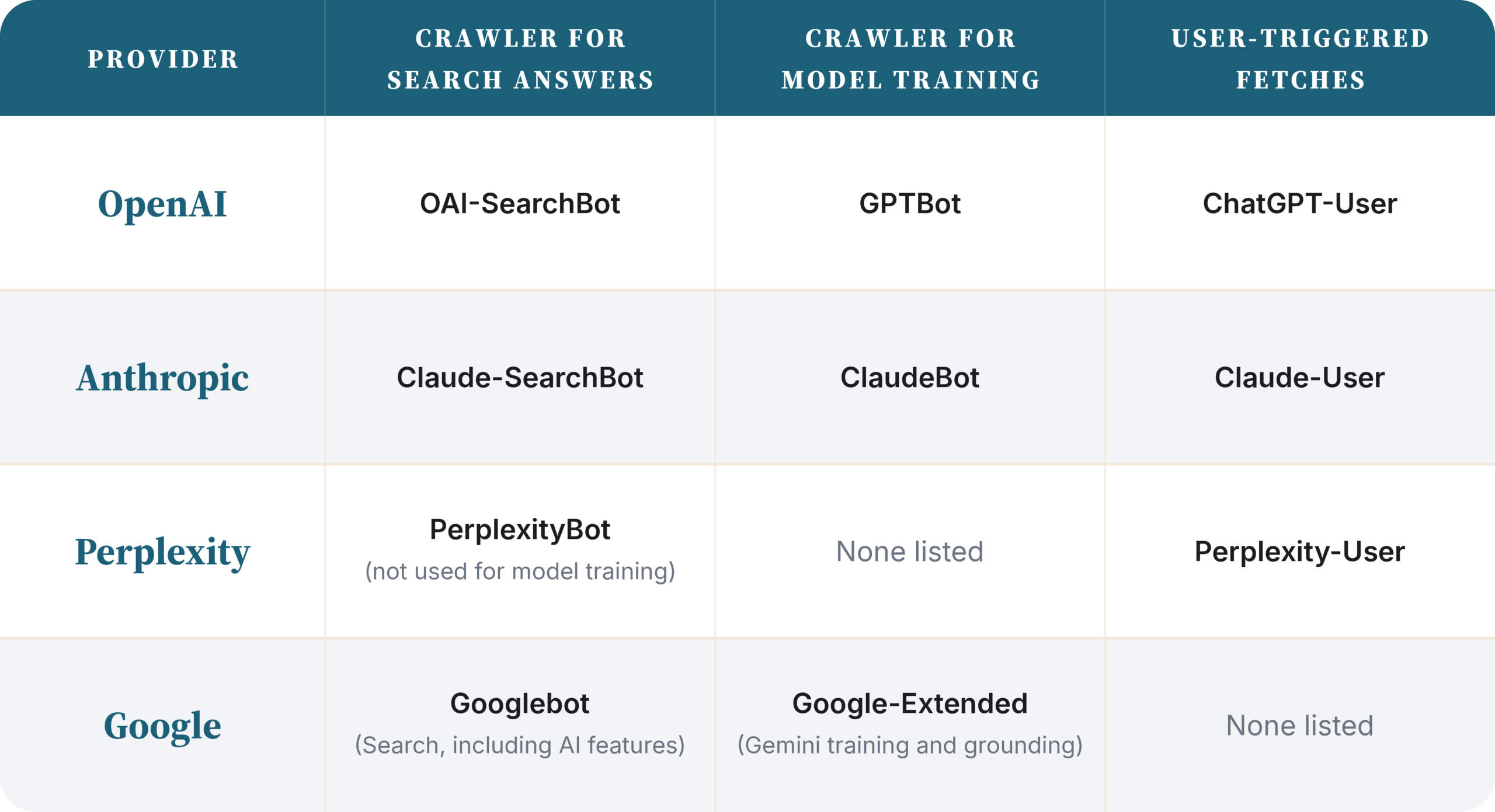
Three points to note. OpenAI says sites that block OAI-SearchBot will not appear in ChatGPT search answers, though they may still show as navigational links. Google says Google-Extended does not affect inclusion or ranking in Google Search. And user-triggered fetchers, such as ChatGPT-User and Perplexity-User, may not follow robots.txt because a person asked for the page.
For most B2B publishers and brands that want to be cited, the practical default is to allow the search crawlers. Whether to allow training crawlers is a separate business decision.
What about llms.txt? It is a proposed file that lists a site’s key pages for language models. There is little public evidence so far that it changes citations, so treat it as optional and low priority. For more on how AI bots affect site traffic, see our article on the rise of AI crawlers.
Layer 2: Entity
AI systems need to understand exactly who you are and what you do. Inconsistency confuses them in the same way it confuses people.
- Use the same company and product names everywhere: your site, LinkedIn, review profiles, and press releases.
- Give every author a real profile page with credentials and links to their professional profiles.
- Keep a clear About page that states what you do, for whom, and where.
- Add accurate organization, person, and article structured data. It does not ensure citations, but it removes ambiguity.
Layer 3: Evidence
This is the layer with the clearest research behind it. The paper that coined the term, “GEO: Generative Engine Optimization” by Aggarwal and colleagues, accepted at KDD 2024, found that its methods could boost visibility in generative engine responses by up to 40%, with results that varied by subject area. Among the approaches it tested were adding citations, quotations, and statistics to content.
For B2B teams that translates into four habits:
- Back every claim with a named, dated source, and link to the original rather than a summary of it.
- Use specific numbers where you have them, with the sample and date.
- Publish original data at least once a year: a survey, a benchmark, or an analysis of your own anonymized data. Content others cannot find elsewhere is content worth citing.
- Show dates. Add the date a page was last reviewed, and update pages when facts change.
Our article on Big Qual in B2B research covers one way to build original research at scale.
Layer 4: Extraction
Because AI systems work with passages, structure your content so the right passage can stand on its own.
- Answer first. Put a direct, 40 to 80 word answer right under the main heading, then explain.
- Write definitions in plain form: “X is a … that …”
- Use tables when comparing more than two things on more than two attributes.
- Use question-style subheadings for the questions buyers actually ask.
- Keep one idea per paragraph, so a single paragraph makes sense out of context.
Before and after
Before: “There are many factors to think about when choosing a CRM, and the best choice will often depend on a range of considerations specific to your organization and its goals.”
After: “The best CRM for a 20-person B2B sales team is usually the one your reps will update daily. Shortlist on three things: pipeline views, email sync, and reporting that answers your forecast questions.”
The second version contains a claim, a context, and a list. A model can quote it. It cannot quote the first.
Layer 5: Endorsement
AI answers draw heavily on what other sites say about you. A brand that is described the same way on review sites, in comparisons, in media, and in community discussions is easier to recommend.
- Keep review profiles current and ask satisfied customers to leave reviews.
- Earn coverage in the publications and newsletters your buyers read.
- Contribute genuinely to communities where your buyers ask questions.
- Make it easy for others to cite you: publish quotable data with clear charts and permission to reuse with credit.
This is classic digital PR and link earning. Our guide to high-quality backlinks covers the methods that still work.
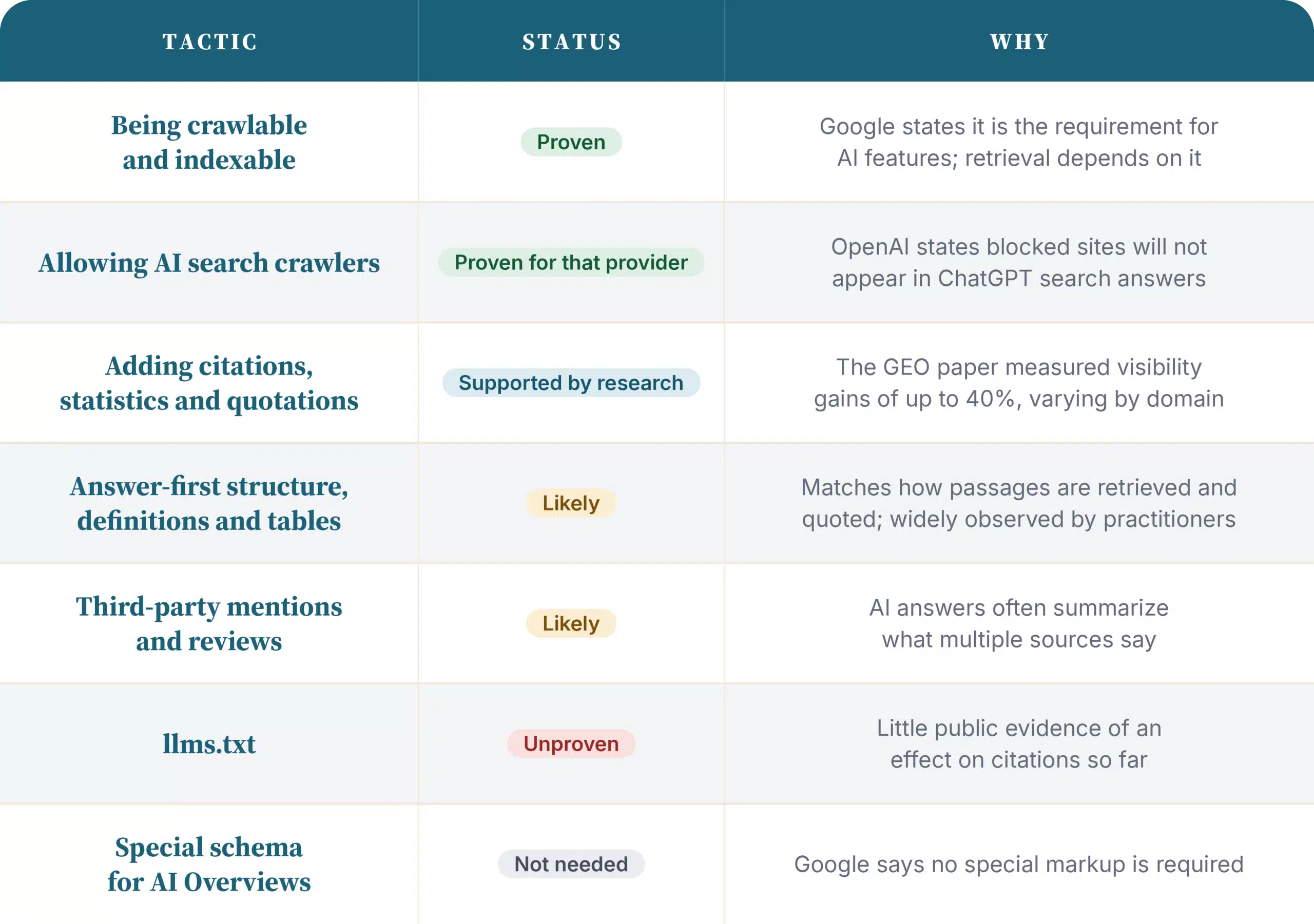
What is proven, likely, and unproven
How to measure AI visibility
Most analytics tools were not built for AI answers, so measurement needs a simple, repeatable method.
1. Track AI referral traffic in GA4.
Create a custom channel group called “AI referrals” that matches sessions from sources such as chatgpt.com, perplexity.ai, gemini.google.com, copilot.microsoft.com, and claude.ai. Place it above the default referral channel so these sessions are counted separately.
2. Run a monthly prompt panel.
Write 25 questions your buyers would ask, such as “best [category] tools for mid-size companies” or “[your brand] vs [competitor].” Each month, run them in ChatGPT, Perplexity, and Google AI Mode, and record whether your brand is cited with a link, mentioned without a link, or absent.
3. Watch the branded search.
In Google Search Console, track impressions for queries that include your brand name. When AI answers mention you, buyers often search for you directly afterward.
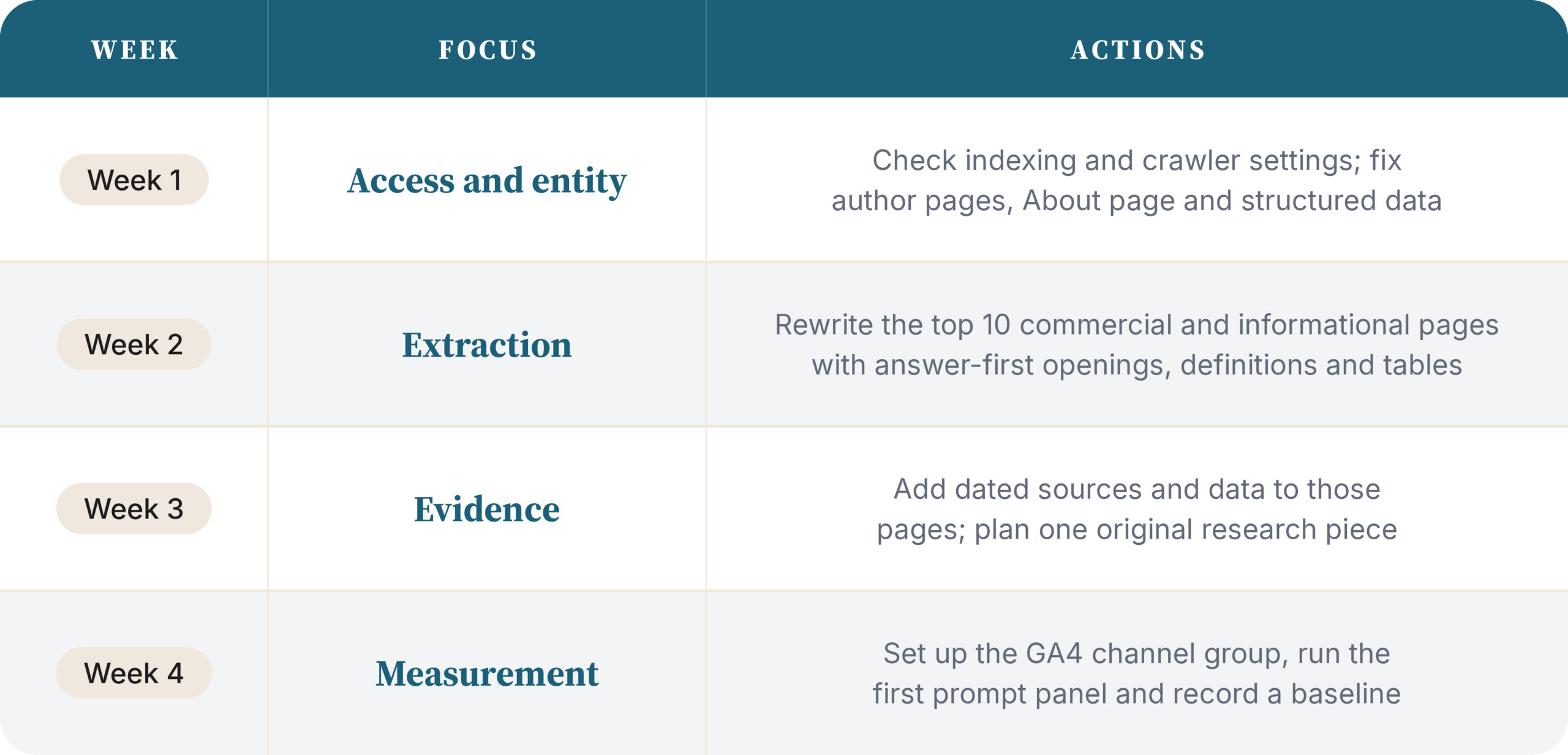
A 30-day generative engine optimization plan for B2B teams
For teams building their site from scratch, our guide to SEO for a new website covers the foundations that every layer above depends on.
FAQs:
Is GEO different from SEO?
GEO builds on SEO rather than replacing it. AI answers mostly draw on crawlable, indexed pages, and GEO adds the structure, evidence and third-party mentions that make a page easier to cite.
Do I need special schema to appear in AI Overviews?
No. Google says there are no extra technical requirements beyond normal Search eligibility, though accurate structured data still helps search engines understand a page.
Should I block AI crawlers?
Blocking search crawlers such as OAI-SearchBot removes you from those answers. Training crawlers such as GPTBot and Google-Extended are a separate choice and can be blocked without affecting search visibility.
Does llms.txt help AI visibility?
There is little public evidence so far that it changes citations. Treat it as optional and low priority.
How do I know if AI tools cite my site?
Track AI referrals in GA4 and run a fixed set of buyer questions each month in ChatGPT, Perplexity and Google AI Mode, recording citations and mentions.
How long does GEO take to work?
Changes to pages that are already indexed can be picked up after the next crawl. Brand-level visibility builds over months as evidence and mentions accumulate.