
Ask ChatGPT for the best tools in your category twice, and you will often get two different lists. Ask Perplexity the same question, and you may get a third. That is the core problem with AI visibility tracking: the thing you want to measure does not sit still.
This guide shows a method that works with that randomness instead of ignoring it. You build a panel of real buyer prompts, run each one several times across the engines your buyers use, and measure rates rather than positions. You can run it in a spreadsheet, and the same metrics carry over if you later buy a tool.
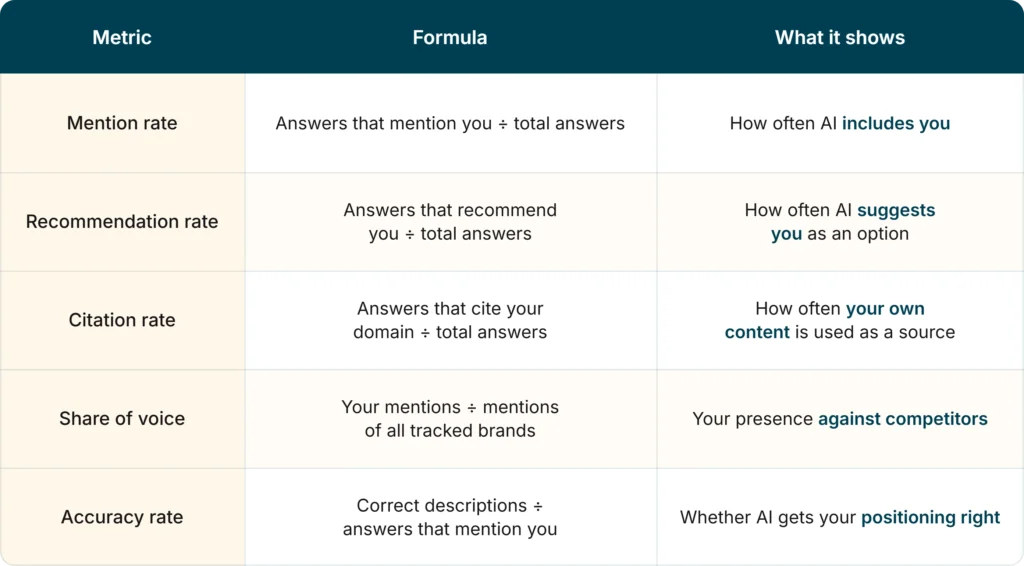
| Quick answer: AI visibility tracking measures how often AI assistants such as ChatGPT, Perplexity, and Google AI Mode mention, recommend, and cite your brand when answering questions your buyers ask. Because AI answers vary between runs, track rates across repeated runs, not single rankings. The four core metrics are mention rate, citation rate, share of voice against competitors, and accuracy of how your brand is described. |
Why rank tracking does not work in AI answers
In January 2026, SparkToro’s Rand Fishkin and Gumshoe.ai’s Patrick O’Donnell published a study in which 600 volunteers ran 12 identical prompts through ChatGPT, Claude, and Google’s AI nearly 3,000 times. Search Engine Land reported that the odds of getting the same list of brands twice were under 1 in 100, and the odds of the same list in the same order were closer to 1 in 1,000.
The same study found something more useful: some brands appeared in 60% to 90% of responses for a given intent. Whether you appear is far more stable than where you appear. That is why this method measures appearance rates and treats position as noise.
AI visibility tracking in six steps
Step 1: Build a prompt panel from real buyer questions.
Your panel is the fixed set of prompts you will run every month. Start with 20 to 40 prompts, split across four types:
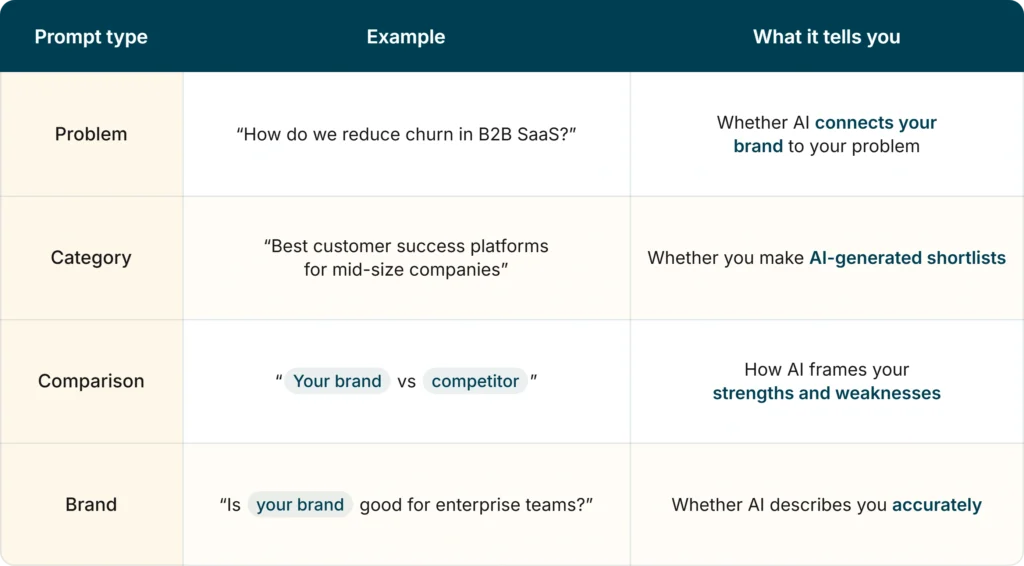
Source prompts from sales calls, onboarding calls, support tickets, and Search Console queries, not only from what a tool suggests. Search Engine Journal’s guide to AI visibility measurement makes the same point: tools tend to suggest prompts that match your existing pages, which can miss the questions buyers actually ask.
Step 2: Choose the engines your buyers use.
Pick three or four. For most B2B brands, that means ChatGPT, Google AI Mode or AI Overviews, Perplexity, and either Gemini, Copilot, or Claude, depending on your audience. Track each engine separately, so a change on one platform does not hide inside an average.
Step 3: Control the test conditions
- Use a clean session: log out where possible, or switch memory and personalization off.
- Keep the location and language setting the same each month.
- Record the date and, where shown, the model or mode used.
- Paste prompts exactly as written in the panel. Small wording changes alter answers.
Step 4: Run every prompt several times.
Run each prompt at least three times per engine in each tracking cycle. With 30 prompts, three engines, and three runs, that is 270 answers a month. It sounds like a lot, but it is what turns a random snapshot into a measurement.
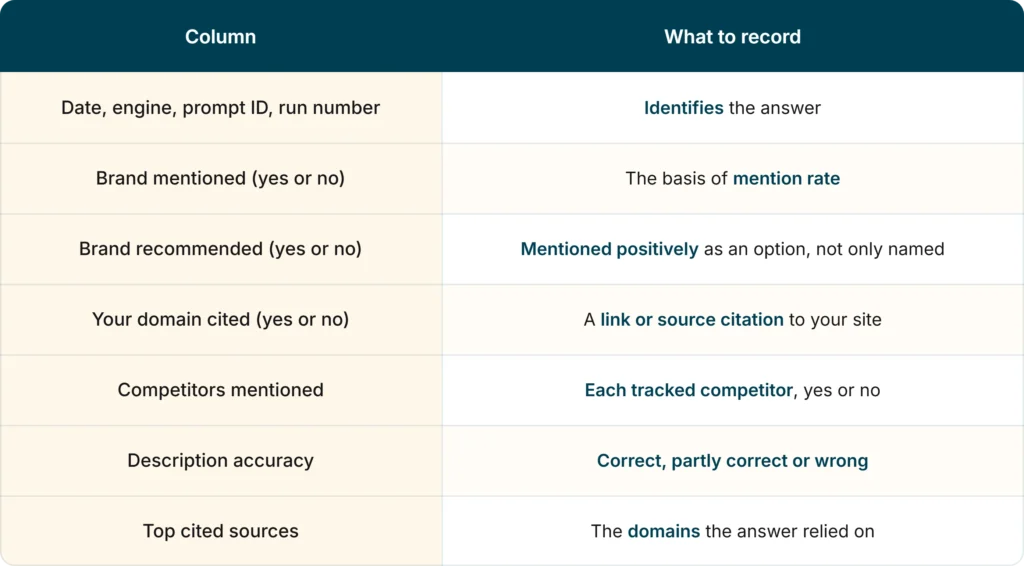
Step 5: Log each answer in a tracking sheet
Step 6: Calculate the AI visibility tracking metrics
A worked example
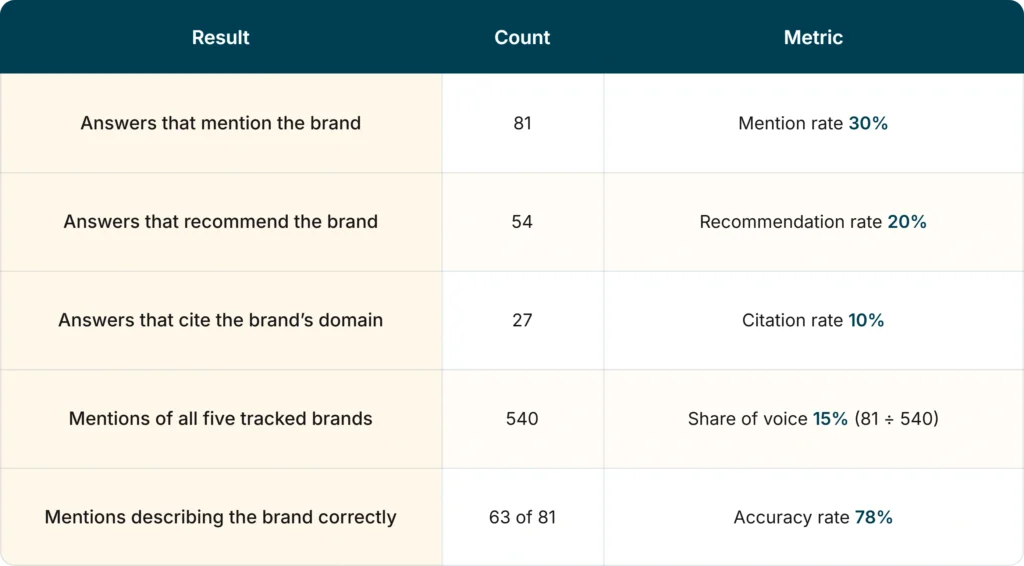
An illustrative B2B software brand runs 30 prompts across three engines, three times each, for 270 answers.
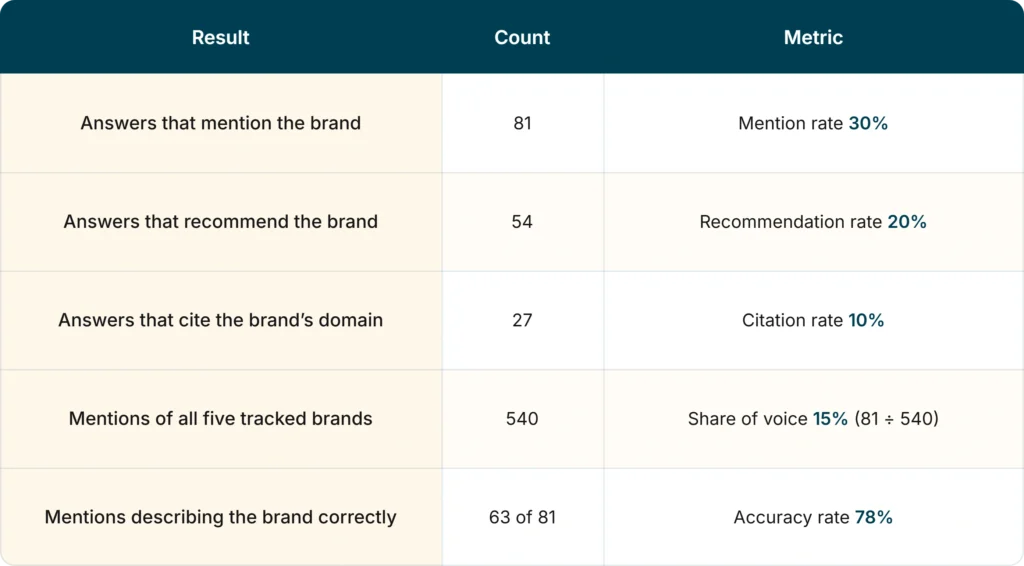
The story in these numbers is clear. The brand appears in under a third of answers, and in about a fifth of the answers that do mention it, the description is wrong. Fixing the description is often faster than raising the mention rate: correct outdated facts on review sites, partner pages, and your own product pages, then measure again next month.
What to do with the results
For the content and authority side of improving these numbers, see our guide to answer engine optimization. Links from trusted sites still shape which sources AI relies on, as covered in our guide to high-quality backlinks. Access matters too: if AI crawlers cannot read your pages, they cannot cite them, as our article on the rise of AI crawlers explains.
Connecting AI visibility to pipeline
AI visibility tracking only matters if it reaches revenue. Two simple additions close the loop:
- Add a free-text “How did you hear about us?” field to demo and contact forms, and tag answers that mention ChatGPT, Perplexity, or other AI tools.
- Create a channel group in your analytics for referrals from AI platforms, while accepting that many AI-driven visits arrive without a referrer and show up as direct traffic.
The SEJ guide reports that, across the author’s clients, 80% to 90% of leads from AI platforms were tagged as organic or direct in the CRM. Self-reported attribution catches what analytics misses.
When to move from a spreadsheet to an AI visibility tool
The manual method works well up to a few dozen prompts. Consider a dedicated tool when you need more than 100 prompts, daily data, several markets or languages, or automated competitor tracking. Platforms in this space include the Semrush AI Visibility Toolkit, Profound, and Peec AI, among many others. Before buying, ask:
- Does it run each prompt several times and report rates, or one run and a rank?
- Can we import our own prompts instead of only using suggested ones?
- Which engines does it query, and does it use the live consumer products or the API models behind them?
- Does it show the sources each answer cited?
- Can we export raw answers to check their counts?
Keep the same metric definitions when you switch, so your history stays comparable.
FAQs:
What is AI visibility tracking?
It is measuring how often AI assistants mention, recommend, and cite your brand when answering your buyers’ questions, tracked over time and against competitors.
Can I track my brand in ChatGPT for free?
Yes. Build a prompt panel, run each prompt several times in a clean session, and log the results in a spreadsheet. Tools save time once you track many prompts.
How many times should I run each prompt?
At least three times per engine in each cycle. AI answers change between runs, so single runs are not reliable.
What is AI’s share of voice?
Your brand’s mentions divided by the mentions of all tracked brands across the same set of AI answers.
How often should I measure AI visibility?
Monthly works for most B2B brands, with a quarterly review of the prompt panel itself.
Does ranking first in Google mean AI will mention my brand?
Not necessarily. AI answers draw on many sources, including review sites and publications, so track AI visibility separately from rankings.